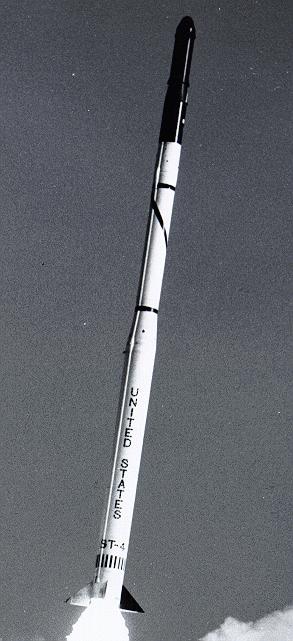
Scout X-1
In-activeNational Aeronautics and Space Administration (NASA)
July 2, 1960
Description
Scout X-1 was an American expendable launch system and sounding rocket which was flown seven times between August 1960 and October 1961.
Specifications
-
Stages
4 -
Length
25.0 m -
Diameter
1.01 m -
Fairing Diameter
― -
Launch Mass
16.0 T -
Thrust
471.0 kN -
Apogee (Sub-Orbital)
185.0 km
Family
-
Name
Scout X-1 -
Family
― -
Variant
X-1 -
Alias
― -
Full Name
Scout X-1
Payload Capacity
-
Launch Cost
$8910000 -
Low Earth Orbit
59.0 kg -
Geostationary Transfer
Orbit
― -
Direct Geostationary
― -
Sun-Synchronous Capacity
―
National Aeronautics and Space Administration
Government
Administrator: Jared Isaacman
NASA 1958The National Aeronautics and Space Administration is an independent agency of the executive branch of the United States federal government responsible for the civilian space program, as well as aeronautics and aerospace research. NASA have many launch facilities but most are inactive. The most commonly used pad will be LC-39B at Kennedy Space Center in Florida.
Scout X-1 | P-21
National Aeronautics and Space Administration | United States of AmericaWallops Flight Facility, Virginia, USA
Oct. 19, 1961, 5:38 p.m.
Scout X-1 | Explorer 13
National Aeronautics and Space Administration | United States of AmericaWallops Flight Facility, Virginia, USA
Aug. 25, 1961, 6:29 p.m.
Scout X-1 | S-55
National Aeronautics and Space Administration | United States of AmericaWallops Flight Facility, Virginia, USA
June 30, 1961, 5:09 p.m.
Scout X-1 | Explorer 9
National Aeronautics and Space Administration | United States of AmericaWallops Flight Facility, Virginia, USA
Feb. 16, 1961, 1:05 p.m.
Scout X-1 | NASA S-56
National Aeronautics and Space Administration | United States of AmericaWallops Flight Facility, Virginia, USA
Dec. 4, 1960, 9:14 p.m.
Falcon 9
Cygnus CRS-2 NG-24 (S.S. Steven R. Nagel)
Space Launch Complex 40 - Cape Canaveral SFS, FL, USAThis is the 24th flight of the Orbital ATK's uncrewed resupply spacecraft Cygnus and its 23rd flight to the International Space Station under the Com…
Smart Dragon 3
SatNet test satellite
South China Sea (launch location 3) - Haiyang Oriental SpaceportOfficially described as "Satellite-Internet Technology Demonstration Satellite". Probable 1 (?) test satellite for the Chinese state-owned LEO commun…
Falcon 9
Starlink Group 17-21
Space Launch Complex 4E - Vandenberg SFB, CA, USAA batch of 25 satellites for the Starlink mega-constellation - SpaceX's project for space-based Internet communication system.
Long March 6A
SatNet LEO Group 21
Launch Complex 9A - Taiyuan Satellite Launch Center, People's Republic of ChinaA batch of 5 Low Earth Orbit communication satellites for the Chinese state owned SatNet constellation operated by the China Satellite Network Group.…
Long March 8
SpaceSail Polar Group 07
Commercial LC-1 - Wenchang Space Launch Site, People's Republic of China18 Low Earth Orbit communication satellites with Ku, Q and V band payloads for the G60 constellation operated by Shanghai Spacesail Technologies with…

