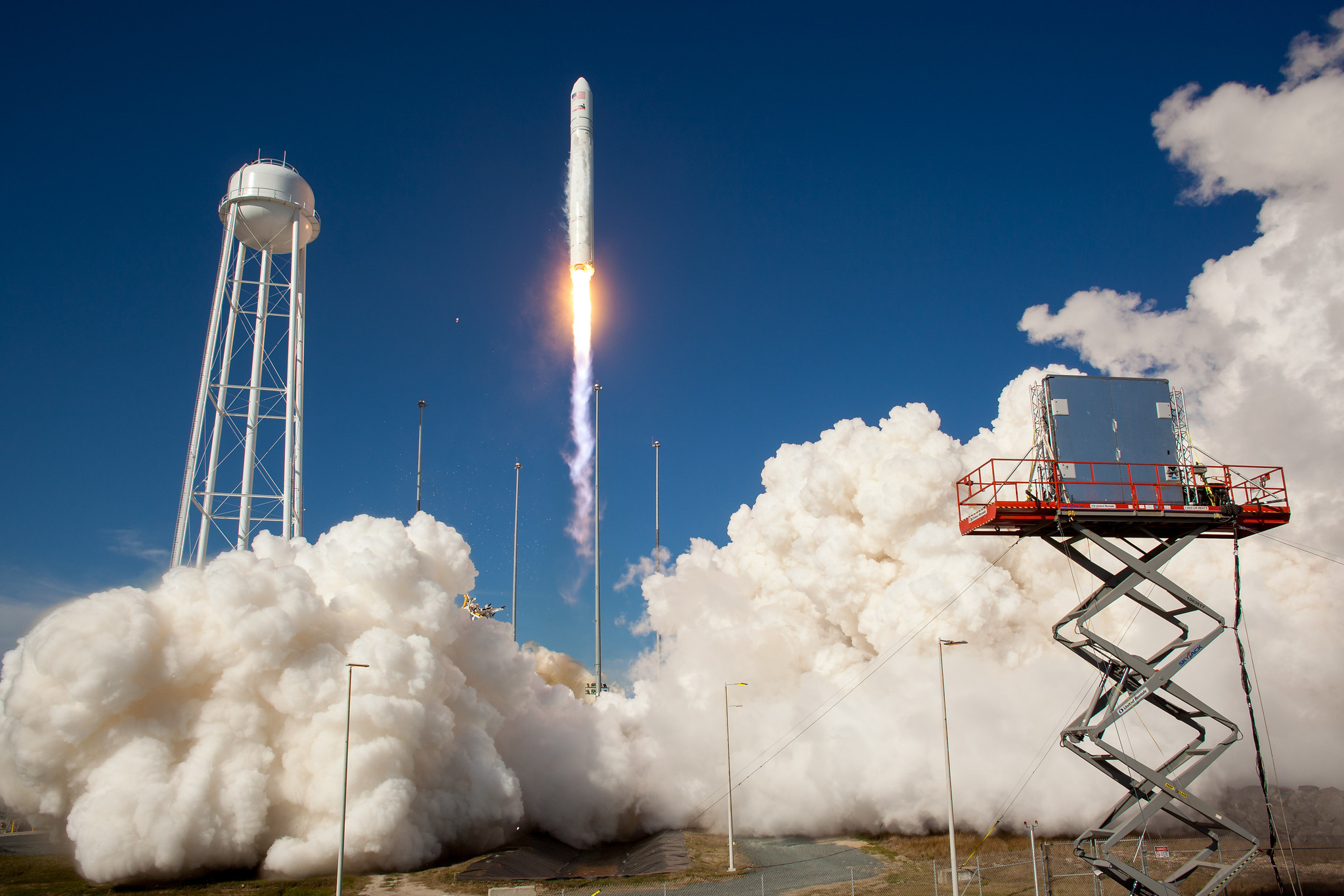
Antares 110
In-activeOrbital Sciences Corporation (OSC)
April 21, 2013
Description
Antares known during early development as Taurus II, is an expendable launch system developed by Orbital Sciences Corporation (now part of Northrop Grumman Innovation Systems after Northrop Grumman acquired Orbital ATK) and the Yuzhnoye Design Bureau to launch the Cygnus spacecraft to the International Space Station as part of NASA's COTS and CRS programs. Able to launch payloads heavier than 5,000 kg (11,000 lb) into low-Earth orbit, Antares is the largest rocket operated by Orbital ATK. Antares launches from the Mid-Atlantic Regional Spaceport and made its inaugural flight on April 21, 2013.
Specifications
-
Minimum Stage
1 -
Max Stage
2 -
Length
40.5 m -
Diameter
3.9 m -
Fairing Diameter
― -
Launch Mass
276.0 T -
Thrust
3265.0 kN
Family
-
Name
Antares 110 -
Family
― -
Variant
110 -
Alias
― -
Full Name
Antares 110
Payload Capacity
-
Launch Cost
― -
Low Earth Orbit
4450.0 kg -
Geostationary Transfer
Orbit
― -
Direct Geostationary
― -
Sun-Synchronous Capacity
―
Orbital Sciences Corporation
Commercial
None
OSCAntares 110 | Cygnus Orb-1 (S.S. G. David Low)
Orbital Sciences Corporation | United States of AmericaWallops Flight Facility, Virginia, USA
Sept. 18, 2013, 2:58 p.m.
Status: Launch Successful
Mission:
This is the demonstration mission under NASA's Commercial Resupply Service agreement with Orbital Sciences. The unmanned Cygnus cargo vessel delivered approximately 700kg of supplies and science experiments to the International Space Station.
Low Earth OrbitFalcon 9
Cygnus CRS-2 NG-24 (S.S. Steven R. Nagel)
Space Launch Complex 40 - Cape Canaveral SFS, FL, USAThis is the 24th flight of the Orbital ATK's uncrewed resupply spacecraft Cygnus and its 23rd flight to the International Space Station under the Com…
Smart Dragon 3
SatNet test satellite
South China Sea (launch location 3) - Haiyang Oriental SpaceportOfficially described as "Satellite-Internet Technology Demonstration Satellite". Probable 1 (?) test satellite for the Chinese state-owned LEO commun…
Falcon 9
Starlink Group 17-21
Space Launch Complex 4E - Vandenberg SFB, CA, USAA batch of 25 satellites for the Starlink mega-constellation - SpaceX's project for space-based Internet communication system.
Long March 6A
SatNet LEO Group 21
Launch Complex 9A - Taiyuan Satellite Launch Center, People's Republic of ChinaA batch of 5 Low Earth Orbit communication satellites for the Chinese state owned SatNet constellation operated by the China Satellite Network Group.…
Long March 8
SpaceSail Polar Group 07
Commercial LC-1 - Wenchang Space Launch Site, People's Republic of China18 Low Earth Orbit communication satellites with Ku, Q and V band payloads for the G60 constellation operated by Shanghai Spacesail Technologies with…

