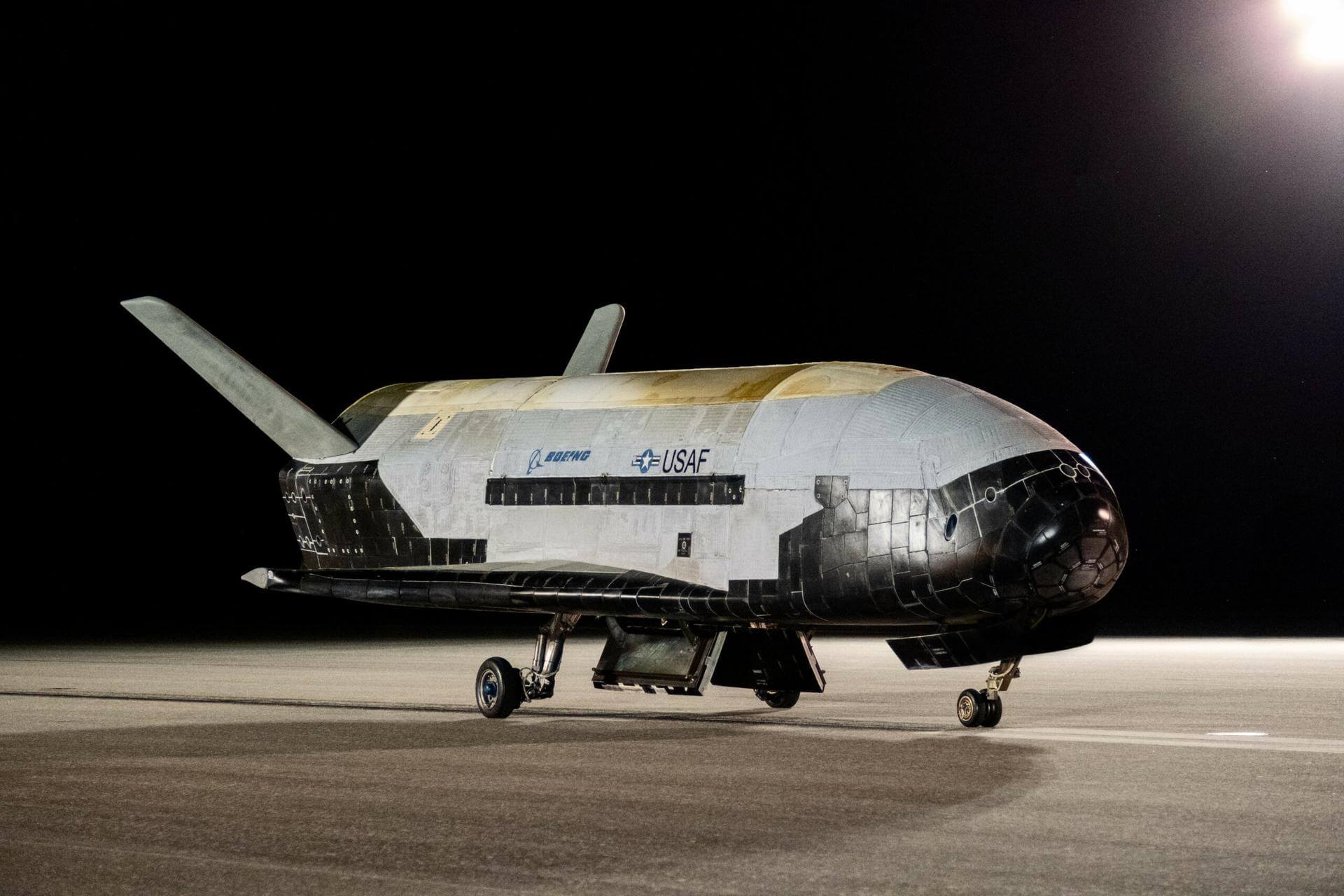
X-37B
Active Cargo Spaceplane Payload Capacity: 227 kg Diameter: 4.55 m Height: 8.92 m()
April 22, 2010
It is boosted into space by a launch vehicle, then re-enters Earth's atmosphere and lands as a spaceplane. The X-37 is operated by the United States Space Force for orbital spaceflight missions intended to demonstrate reusable space technologies.
Flight Life
Multiple years in orbit
Description
The Boeing X-37, also known as the Orbital Test Vehicle (OTV), is a reusable robotic spacecraft. It is boosted into space by a launch vehicle, then re-enters Earth's atmosphere and lands as a spaceplane. The X-37 is operated by the United States Space Force for orbital spaceflight missions intended to demonstrate reusable space technologies. It is a 120-percent-scaled derivative of the earlier Boeing X-40. The X-37 began as a NASA project in 1999, before being transferred to the United States Department of Defense in 2004. Until 2019, the program was managed by Air Force Space Command.
History
In 1999, NASA selected Boeing Integrated Defense Systems to design and develop an orbital vehicle, built by the California branch of Boeing's Phantom Works. Over a four-year period, a total of US$192 million was spent on the project, with NASA contributing US$109 million, the U.S. Air Force US$16 million, and Boeing US$67 million. In late 2002, a new US$301 million contract was awarded to Boeing as part of NASA's Space Launch Initiative framework. The X-37 was transferred from NASA to the Defense Advanced Research Projects Agency (DARPA) on 13 September 2004. Thereafter, the program became a classified project. DARPA promoted the X-37 as part of the independent space policy that the United States Department of Defense has pursued since the 1986 Challenger disaster.
Long March 6A
SatNet LEO Group 21
Launch Complex 9A - Taiyuan Satellite Launch Center, People's Republic of ChinaA batch of 5 Low Earth Orbit communication satellites for the Chinese state owned SatNet constellation operated by the China Satellite Network Group.…
Long March 8
SpaceSail Polar Group 07
Commercial LC-1 - Wenchang Space Launch Site, People's Republic of China18 Low Earth Orbit communication satellites with Ku, Q and V band payloads for the G60 constellation operated by Shanghai Spacesail Technologies with…
Minotaur IV
STP-S29A
Space Launch Complex 8 - Vandenberg SFB, CA, USASTP-S29A is a mission under the U.S. Department of Defense's Space Test Program (STP) that will deliver technology demonstrations to orbit and contri…
Falcon 9
Starlink Group 17-35
Space Launch Complex 4E - Vandenberg SFB, CA, USAA batch of 25 satellites for the Starlink mega-constellation - SpaceX's project for space-based Internet communication system.
Atlas V 551
Amazon Leo (LA-05)
Space Launch Complex 41 - Cape Canaveral SFS, FL, USAAmazon Leo, formerly known as Project Kuiper, is a mega constellation of satellites in Low Earth Orbit that will offer broadband internet access, thi…
Soyuz 2.1a/Fregat-M
Meridian-M No.21L
43/3 (43L) - Plesetsk Cosmodrome, Russian FederationNote: Payload identity uncertain. Meridian is a series of communications satellite for military and civilian use.
Tianlong-3
Demo Flight
Tianlong-3 Launch Pad - Jiuquan Satellite Launch Center, People's Republic of ChinaFirst test launch of Space Pioneer’s Tianlong-3 rocket.
Falcon 9
Starlink Group 10-58
Space Launch Complex 40 - Cape Canaveral SFS, FL, USAA batch of 29 satellites for the Starlink mega-constellation - SpaceX's project for space-based Internet communication system.
Space Launch System (SLS)
Artemis II
Launch Complex 39B - Kennedy Space Center, FL, USAArtemis II is the first crewed mission as part of the Artemis program. Artemis II will send a crew of 4 - 3 Americans and 1 Canadian around the moon …
Falcon 9
Starlink Group 10-44
Space Launch Complex 40 - Cape Canaveral SFS, FL, USAA batch of 29 satellites for the Starlink mega-constellation - SpaceX's project for space-based Internet communication system.

